

“My lower back seized up…,” “I think I’m getting sciatica…,” “I felt a sharp twinge…,” “a shooting pain”—these are the phrases most often used by people who have experienced a sudden, sharp pain in their back. This is lumbago. And indeed, it most closely resembles a “shooting pain.” What should you do when pain strikes? Viktoria Vitaliivna Petlytska, a neurologist at the Bersenev Medical Center, will discuss this fairly common “ailment” in an accessible and engaging way.
Lumbago is unpredictable. Imagine—it can happen when you sneeze or cough, and even during sex!
Back pain is very insidious; it often feels similar, but it’s important to distinguish between different types in order to choose the right treatment strategy. Lumbago—a sharp pain or “lumbago” in the lower back—can strike suddenly and throw all our plans into disarray. The pain is so unexpected and intense that a person simply freezes in one position and can’t always take a step. Most often, the pain subsides slightly if the person assumes a forced position, but intensifies with any attempt to change posture. The shooting pain may subside in a few minutes, or it may last a whole week, exhausting you with pain even when you try to cough.
One moment you were healthy and happy, humming cheerfully as you got ready for work or a party, took a shower… And suddenly—as if a sharp needle had pierced your spine! Or was it different? Did you bend down for a bag and couldn’t straighten up again? Or maybe you just got out of bed as usual in the morning… Yes, lumbago always strikes unexpectedly. No prior aching, no hints that your back is preparing a “surprise” for you. Over time, the sharp pain can radiate into your buttocks and legs, becoming unbearable.
Sometimes the pain subsides fairly quickly, and then, blaming your own carelessness, you simply start moving less, avoiding dangerous bending and squatting, and leading a more sedentary lifestyle. However, this is no guarantee that the pain won’t return in a few days!
Particular suffering is caused by pain that lasts for several days, intensifies with movement, and eventually begins to cause problems even during urination and bowel movements. Of course, you must not let things get to this point—you need to ask your loved ones for help and urgently see a neurologist.
Who is more prone to experiencing lumbago?
“Is it really old age?” you think resignedly, recalling your grandmother, whom you once had to “rescue” from yard work. A neurologist will reassure you—it’s not necessarily old age. Lumbago is indeed a condition more common in older people, but a sudden back spasm can strike you at 25 or 30. Although it does tend to occur more frequently after age 40.
Lumbago loves extremes. On the one hand, it often occurs in people who engage in heavy physical labor: lifting heavy objects, making sudden movements, or spending a lot of time bent over. But the backs of people who lead a sedentary lifestyle are also a favorite target of lumbago! Especially if there is significant excess weight.
Should you see a doctor if the episode went away on its own quickly?
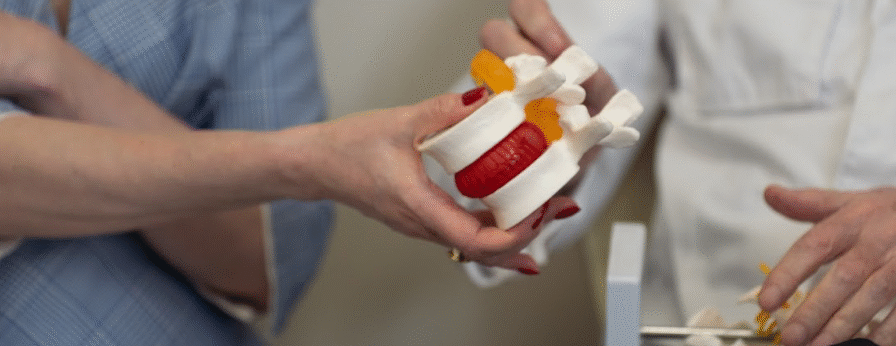
The fact is that neurologists do not consider lumbago to be a separate disease. And the cause of a sudden shooting pain can be any of dozens of completely different reasons. These include herniated discs, injuries, spondyloarthritis, myofascial syndrome, microtears in the annulus fibrosus, and even benign and malignant tumors and infectious lesions of the spine. Do most of these terms mean nothing to you? Then you shouldn’t try to figure it out on your own, and certainly shouldn’t attempt to diagnose yourself.
Lumbago is never random; it always indicates that your back requires immediate attention and a thorough examination. And you shouldn’t put it off, because the condition could be quite serious. In any case, the sooner you decide to find out the cause of your lumbago, the better your chances of treating the underlying condition.
How can you relieve the pain?
Your doctor will take care of that. Of course, the first priority will be to relieve the pain—using painkillers. Then, based on a clinical examination, tests will be ordered to determine the underlying diagnosis that caused the lumbago. You may be scheduled for a CT scan, MRI, X-ray, or other tests. Treatment will be selected based on the test results. Sometimes medication, massage, and physical therapy are sufficient. At the Bersenev Medical Center, we actively and successfully implement a proprietary metameric method for treating spinal issues, whose advantage lies in the mathematical precision of its effect on cells and nerve endings.
In extremely advanced cases, the assistance of neurosurgeons may be required. But, of course, it is better not to let it come to that. Therefore, at the very first episode of lumbago, even if it resolved quickly on its own, make time to see a neurologist. If only to ensure that the next episode does not catch you off guard. That said, there’s never a good time for pain.






 by bus No. 7 (on weekdays)
  by bus No. 181
  by trolleybus No. 6, 16, 18